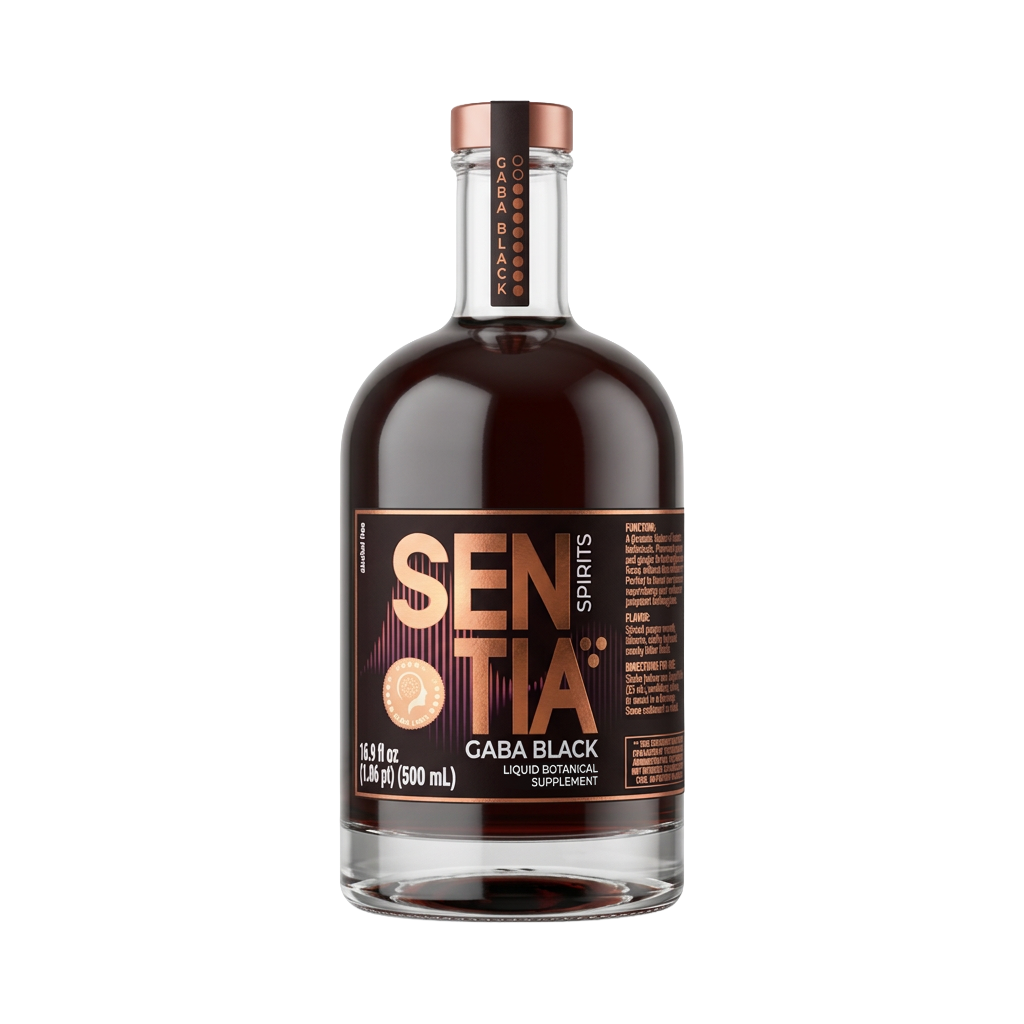
A peer-reviewed open-access scientific review
Functional Alternatives to Alcohol was published in Nutrients in 2022. It is a peer-reviewed, open-access scientific review authored by Professor David Nutt, Robin J. Tyacke, Meg J. Spriggs, Alan D. Borthwick and Delia Belelli. The paper was authored by members of the GABA Labs Science Team. Its discussion of alcohol, GABA-A receptors and functional alternatives helps explain the scientific thinking that sits behind SENTIA’s development.
What does Functional Alternatives to Alcohol say?
Functional Alternatives to Alcohol asks whether drinks could be developed to support some of the social effects people value in alcohol, without using ethanol.
The paper looks at how alcohol acts in the brain, including its early effects on the GABA system, then explores whether botanical or synthetic approaches could offer a more targeted route. This research helps explain why SENTIA focuses on GABA, sociability and alcohol-free functional drinks.
What question does this paper address?
The paper starts with a deceptively simple question: can we separate the social effects people often want from alcohol from the wider effects they would rather avoid?
People rarely choose a drink because they are fascinated by ethanol itself. They are usually looking for what comes with the occasion: feeling more at ease, joining in, talking more freely or becoming a little less self-conscious. The paper asks whether science can understand those effects well enough to design something more selective.
That moves the conversation beyond making another alcohol-free drink that simply looks or tastes the part. The bigger question is whether a functional drink can be designed around the reason many people reach for alcohol in the first place.
Why are GABA and GABA-A receptors relevant?
GABA is the brain’s main inhibitory neurotransmitter. One of its jobs is to help keep neural activity from becoming overexcited. GABA-A receptors are an important part of that calming system. The paper explains that some of alcohol’s relaxing and sociability-related effects at lower doses are thought to involve the GABA system. In everyday terms, GABA helps the brain turn down the volume when neural activity gets too loud.
Alcohol is much less selective. Early on, GABA-related effects may contribute to feeling more relaxed or socially at ease. As alcohol levels rise, other neurotransmitter systems become more involved, including glutamate, dopamine and endorphins. This broader activity helps explain why a relaxed first drink can eventually give way to poorer coordination, muddled memory, disrupted sleep and a rougher next day.
GABA-A receptors matter here because they are one of the important places where alcohol interacts with the brain’s inhibitory system. The paper explores whether targeting parts of that system more selectively could offer a route towards functional alternatives to alcohol.
What approaches to functional alcohol alternatives does it examine?
The paper looks at two main routes: botanicals and synthetic compounds.
The botanical route considers plants and food-derived ingredients that contain compounds with evidence of activity related to the GABA system. This is particularly relevant to SENTIA as a botanical functional spirit. The review discusses naturally occurring compounds found within the human food chain, including plants with a history of use in traditional drinks as well as research into GABA-related activity.
The synthetic route takes a more pharmacological approach. It considers designed molecules that could, in theory, act more precisely at receptor subtypes. That possibility also brings significant questions around safety, testing and regulation.
Both approaches start in the same place: understand the brain mechanism first, then investigate whether there are more selective ways to support the effects people value without relying on ethanol.
Why is this publication relevant to SENTIA?
This publication matters to SENTIA because it lays out the scientific thinking behind functional alternatives to alcohol. The focus is on the function people seek from a drink, as well as the flavour and ritual around it.
That is close to the idea SENTIA was built around. A social drink has a job to do in the moment: it sits on the dinner table, marks the end of the working day, comes out when friends meet and becomes part of the rhythm of an evening. SENTIA was developed with those occasions in mind, alongside the neuroscience of why alcohol has played that role so successfully.
The paper therefore provides useful scientific context for SENTIA’s focus on GABA, GABA-A receptors, botanicals, sociability and the wider development of functional alcohol alternatives.
The boundary is important, though. This paper explains the scientific landscape that informed SENTIA’s development; it is not a finished-product trial of SENTIA.
What does this publication not prove?
This publication does not establish that SENTIA is clinically effective as a finished product. It is a scientific review, not a clinical trial of SENTIA. It does not show that SENTIA treats anxiety, prevents disease, guarantees a particular feeling or has been clinically proven safer than alcohol. The most useful way to read it is as a map of the science and the development rationale. It shows why GABA, GABA-A receptors, sociability and functional alternatives to alcohol are connected areas of research. Finished-product evidence is a separate question.
Key findings and themes
1. Alcohol’s social appeal is partly functional
The paper recognises that alcohol is popular partly because of what people feel it adds to social situations. Alcohol-free drinks can recreate the glass, flavour and ritual very well. Functional alternatives ask whether the experience can go further by considering relaxation and social ease too.
2. GABA is central to alcohol’s early calming effects
The review describes GABA as the brain’s main inhibitory neurotransmitter and explains why GABA-A receptors are part of the story behind alcohol’s early relaxing and sociability-related effects.
3. Alcohol is a blunt tool
Alcohol affects far more than the GABA system. As the amount consumed rises, other systems become increasingly involved, including glutamate, dopamine and endorphins. That wider pharmacology is part of the reason alcohol’s effects can become less predictable and less welcome.
4. Functional alternatives aim to be more selective
The paper explores whether a more selective approach could focus more closely on the social effects people value, without using ethanol and without reproducing alcohol’s broad pharmacology.
5. Botanicals are one possible route
Botanicals are one avenue the paper considers. It looks at naturally occurring plant compounds with potential GABA-related activity, including ingredients already used in foods, supplements or traditional drinks.
6. Bioavailability matters
A botanical formula is more than a roll call of interesting plants. The paper also looks at bioavailability: whether useful compounds can be absorbed and reach the places where they may have an effect.
7. Safety and regulation are essential
Any credible functional alcohol alternative also must work outside the lab. The paper highlights food safety, regulation and the practical challenge of turning scientific ideas into drinks people can buy and use.
In plain English...
Alcohol became such a successful social drink because it changes how people feel. For many people, the part they are looking for comes early: feeling a little more relaxed, less guarded and more open to the people around them.
The difficulty is that alcohol keeps going. Its effects spread across several brain systems and the body, which is why the experience can move well beyond the relaxed social feeling that started it.
Functional Alternatives to Alcohol asks whether we can understand that early, sociable part more precisely and use that knowledge to explore alternatives. GABA matters because it is one of the brain’s main inhibitory systems, and GABA-A receptors are thought to be involved in some of alcohol’s early social and relaxing effects.
For SENTIA, that changes the starting point. Instead of trying to copy alcohol in every respect, the aim is to design a functional drink around the social experience people were seeking in the first place.
For scientific and technical readers
Functional Alternatives to Alcohol reviews alcohol’s pharmacology with particular attention to GABAergic mechanisms. It discusses how alcohol’s effects change with concentration across neurotransmitter systems, including GABA, glutamate, dopamine and endorphins.
The review gives particular attention to GABA-A receptors, which are ligand-gated chloride channels, and discusses alcohol’s potentiation of GABA at these receptors. It also considers receptor-subtype complexity, positive allosteric modulation and the possibility that more selective modulation could help separate desirable social effects from broader sedative or intoxicating effects.
The botanical section examines naturally occurring materials from plants with GABA-related activity. It also discusses the formulation logic behind combining core GABAergic ingredients with ingredients intended to support bioavailability or the transport of active compounds across the blood-brain barrier.
The paper also considers synthetic alcohol alternatives, including subtype-selective approaches to GABA-A receptors, while recognising the food-safety and regulatory hurdles involved in bringing novel ingredients into consumer products.
Read the paper
Read the external open-access paper here:
Return to SENTIA’s research hub: https://sentiaspirits.com/pages/our-peer-reviewed-research-alcohol-alternatives
Related SENTIA reading
Explore more of the science behind SENTIA: