If you’ve searched “does ashwagandha affect GABA?”, you’re probably looking for better ways to relax. Maybe you want to wind down without alcohol. Maybe you want to feel more comfortable in social settings. Or maybe you’re looking for something to drink at a party that does more than taste vaguely like a cocktail.
The short answer is yes: adaptogens like ashwagandha may influence the GABA system. But the important part is how.
At SENTIA, ashwagandha is used in GABA Red and GABA Gold as part of a broader botanical blend designed to support the brain’s natural GABA system. It is not there as a token wellness ingredient. It is part of the formula.
GABA: Your Brain’s Social Ease Switch
GABA, short for gamma-aminobutyric acid, is the brain’s main calming messenger. It helps reduce nervous system overactivity and is associated with feeling calmer and less mentally overstimulated.
You can think of GABA as the brain’s social ease switch, helping prevent stress and overthinking from running unchecked.
That’s why GABA is linked to stress, sleep, relaxation and social ease. Alcohol also affects this system, but in a much less precise way, often bringing poor sleep, worse decision-making, memory loss, hangxiety and next-day regret.
So, Does Ashwagandha Affect GABA?
Current research suggests ashwagandha may affect GABA signaling, though not in a simple or direct way.
Ashwagandha is an adaptogen containing withanolides. These compounds are being studied for effects on stress, sleep, cognition, inflammation and brain signaling, including possible links to GABA pathways and stress regulation [1].
Another review on anxiety, depression and insomnia also places ashwagandha’s calming effects partly within a GABA-related picture [2].
The key point is that ashwagandha is not GABA. It appears to modulate GABAergic signaling, meaning it may help support the brain’s calming system rather than become GABA itself.
Does Ashwagandha Increase GABA?
Possibly, but not in the simple way supplement marketing often suggests.
Ashwagandha may support GABA receptor activity and help calm the HPA axis, the system that regulates stress hormones. By helping rebalance stress responses, it may indirectly support calmer signaling in the brain [3].
A 2025 meta-analysis of 15 randomized controlled trials found ashwagandha supplementation was associated with reduced anxiety, perceived stress and cortisol [4].
That is promising, but it still does not make ashwagandha a direct GABA drug. Its value may lie in how it fits into a wider blend.
Why Not Just Take GABA as a Supplement?
This is where many people get confused.
GABA matters in the brain, but taking it orally is not the same as increasing its activity in the brain because of the blood-brain barrier, which limits what enters from the bloodstream.
Most evidence suggests oral GABA does not cross that barrier in meaningful amounts, which may explain why GABA supplements do not always feel effective.
So, GABA is important, but swallowing GABA is not the best way to influence the brain’s GABA system.
Why SENTIA Uses Ashwagandha as Part of a Blend
SENTIA uses ashwagandha as part of a blend rather than as a standalone ingredient. GABA Red and GABA Gold contain ashwagandha because it adds value to a broader functional formula.
The blend is designed so ingredients work together. Some may support natural GABA activity, while others help with absorption and bioavailability. That matters because even a useful ingredient has limited value if the body cannot use it effectively.
Some compounds in SENTIA’s botanical blend may act as positive allosteric modulators, helping the brain’s own GABA work more effectively rather than replacing it.
Rather than relying on ashwagandha alone or oral GABA, SENTIA offers a functional drink built around botanicals, absorption and GABA modulation.
Ashwagandha, GABA and Social Ease
A lot of people investigate ashwagandha and GABA because they want to feel calmer. But calm is not always a solo activity. Sometimes it means feeling more comfortable with other people.
That might be pre-dinner nerves. A work event. A party where you want something in your glass that still feels adult. Or an after-work drink with friends where you want the ritual without the alcohol.
This is where SENTIA is different from a supplement. A capsule can be useful, but it does not give you a drink to pour over ice, hold in your hand, or share in a round.
SENTIA is designed for real social moments: dinners, celebrations, parties, catch-ups, low-key nights in and any occasion where alcohol used to be the default.
What Can I Drink Instead of Alcohol at Parties?
If you want something functional rather than just alcohol-free, SENTIA is designed for social drinking without alcohol.
GABA Gold is the most natural fit for lively social occasions. It is designed for uplift, balance and social ease, with ashwagandha included as part of a broader botanical blend. It works well for parties, dinners, celebrations and those moments when you want to feel present, connected and clear-headed.
GABA Red is more suited to winding down: calmer, softer and ideal for relaxed evenings or post-work decompression.
Both use adaptogens like ashwagandha within a wider SENTIA blend. The difference is the moment you are drinking it for.
Learn more about adaptogen and nootropic drinks
Read about zebra striping and mindful moderation
Supplements vs Functional Spirits
Supplements can be useful, but they do not replace the experience of a drink or social ritual.
SENTIA was designed to fill that gap with a drink people can enjoy in real-life moments.
People searching for ashwagandha and GABA are often looking for calm, stress support, better sleep or social ease. SENTIA turns that interest into a more practical functional drink: something made for the moments where alcohol used to do the heavy lifting.
FAQ: GABA, Ashwagandha and SENTIA
Is GABA the same as ashwagandha?
No. GABA is a neurotransmitter, while ashwagandha is a plant. Ashwagandha may influence GABA signaling, but it is not GABA.
Can I take ashwagandha and GABA together?
Many people combine them, but oral GABA may not reliably reach the brain. If you take medication, are pregnant or breastfeeding, or have a health condition, speak to a doctor or pharmacist first.
Does ashwagandha promote GABA?
Current evidence suggests ashwagandha may support GABAergic signaling, but it is more accurate to say it modulates GABA rather than directly raises it.
Does ashwagandha affect your nervous system?
Yes. Research suggests ashwagandha may influence stress pathways, GABA signaling, inflammation and cortisol responses.
Can ashwagandha help with social anxiety?
Ashwagandha is often used by people looking for calm in stressful situations, and research links it with stress and anxiety measures. But it should not be treated as a cure for social anxiety. If social anxiety is affecting your life, speak to a healthcare professional.
For social occasions, SENTIA offers a functional alcohol-free drink that uses ashwagandha as part of a wider GABA-supporting botanical blend.
What can I drink at a party instead of alcohol?
If you want more than a standard mocktail or soda, SENTIA is designed for social drinking without alcohol. GABA Gold is especially suited to parties, dinners and lively social moments, while GABA Red is better for winding down and relaxed evenings.
Is GABA Gold good for socializing?
GABA Gold is designed for uplift, balance and social ease. It contains ashwagandha as part of a wider botanical blend and is made for moments where you want to feel connected without alcohol.
Can ashwagandha cure brain fog?
No. Brain fog can have many causes, and ashwagandha should not be treated as a cure.
Is ashwagandha good for overthinkers?
It may help some people feel calmer under stress, but it is not a guaranteed off-switch. In SENTIA, it works as part of a wider blend.
What should you never mix with ashwagandha?
If you take medication, especially sedatives, thyroid treatments, immune-related medication or mood-related medication, speak to a healthcare professional before using ashwagandha.
Why don’t some doctors like ashwagandha?
Concerns usually relate to inconsistent supplement quality, possible interactions and claims that go beyond the evidence.
Does ashwagandha feel like CBD?
Not really. Both are used for calm, but they work through different systems.
Which is more calming: ashwagandha or L-theanine?
They serve different purposes: L-theanine is often linked to calm focus, while ashwagandha is more associated with stress resilience.
Is ashwagandha anticancer?
No. Ashwagandha should not be used to treat, cure or prevent cancer.
Ready to Try Ashwagandha in a More Social Way?
If you’re interested in ashwagandha and GABA for calm, connection or unwinding, SENTIA offers a more social functional-drink option.
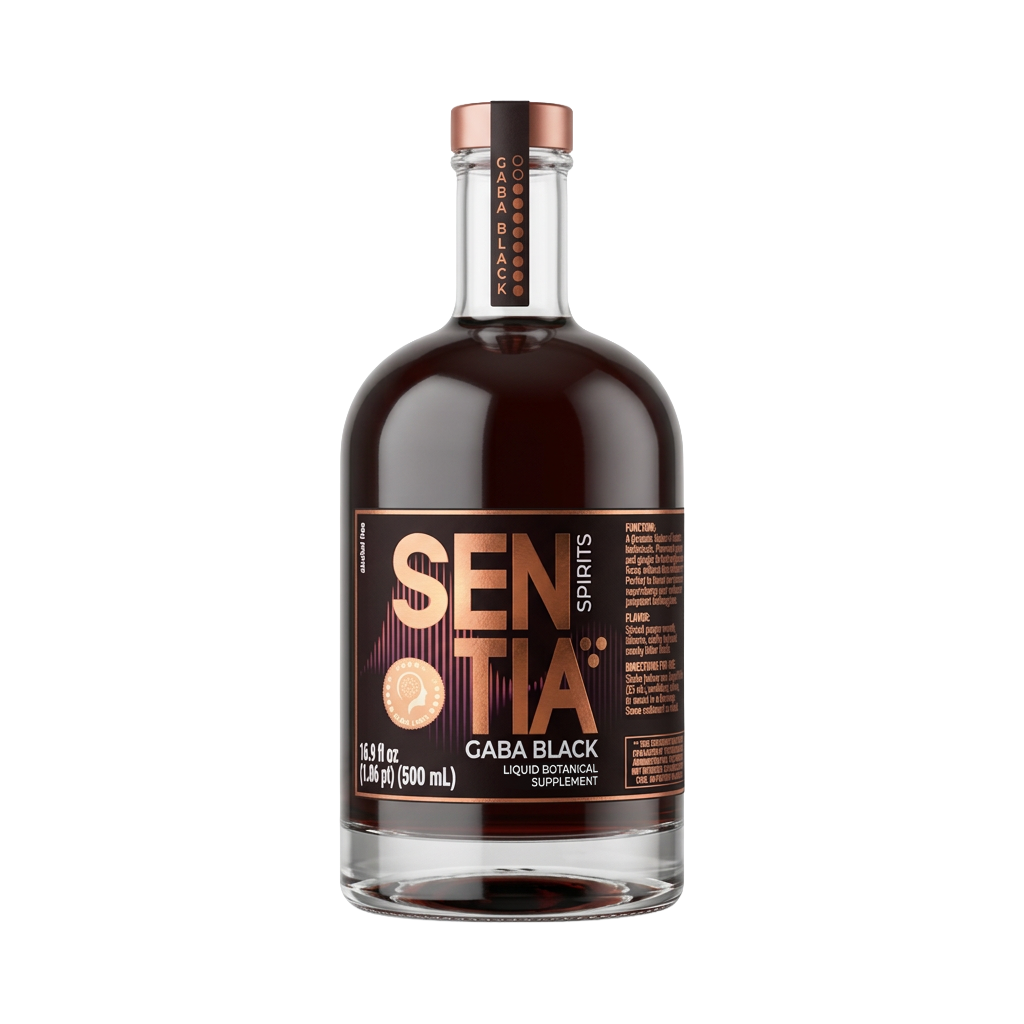
Explore GABA Red, GABA Gold, and GABA Black to find the one that fits your mood.
References
[1] Ashwagandha as an Adaptogenic Herb: A Comprehensive Review of Immunological and Neurological Effects (Cureus, 2025)
[2] The benefits of ashwagandha (Withania somnifera) for anxiety, depression, and insomnia (Frontiers in Nutrition, 2024)
[3] Withania somnifera supplementation: a review of its mechanisms, health benefits, and role in sports performance (Nutrition & Metabolism, 2025)
[4] Effects of Ashwagandha Supplements on Cortisol, Stress, and Anxiety Levels in Adults (BJPsych Open, 2025)