If your brain sometimes feels like it’s running on six coffees and a deadline, the GABA pathway is worth knowing about. In simple terms, it’s one of the brain’s main systems for calming things down. Not switching you off. Not knocking you out. Just helping your nervous system stop shouting over itself.
Here’s the quick, no-lab-coat version.
1. GABA is your brain’s brake pedal
GABA, short for gamma-aminobutyric acid, is the brain’s main inhibitory neurotransmitter. “Inhibitory” sounds technical, but it basically means GABA tells neurons to slow down or stop firing.
Glutamate does the opposite. It excites neurons and helps switch things on. Professor David Nutt describes the pair as the “on and off” of brain activity: glutamate pushes, GABA steadies [1].
That balance is the whole game.
2. The GABA pathway is not one neat road
Despite the name, the GABA pathway isn’t a single little road in the brain. It’s a network of neurons that make, release, receive, and recycle GABA.
When your brain needs to calm activity, GABA is released into the tiny gap between neurons, called the synapse. It then binds to GABA receptors on the next neuron and tells it: take it down a notch.
That’s how the system helps reduce over-excitability and keeps the brain from being permanently “on.”
3. Your body makes GABA from glutamate
One of the coolest bits of brain chemistry is that GABA is made from glutamate — its opposite number.
The enzyme that does this is called glutamic acid decarboxylase, or GAD if you prefer not to say all that at dinner. GAD converts glutamate into GABA, helping maintain the balance between excitation and inhibition [1], [2].
So the brain doesn’t just have a brake and accelerator. It can make the brake from the accelerator. Pretty slick.
4. GABA is released when neurons need calming
When a GABA-producing neuron fires, it releases GABA into the synapse. GABA then binds to receptors on nearby neurons.
The best-known fast-acting receptor is GABA-A. When GABA binds there, it opens a channel that lets negatively charged ions into the neuron. That makes the neuron less likely to fire [1].
In plain English: GABA helps make the brain cell quieter.
There is also GABA-B, which works more slowly and tends to have longer-lasting effects. Fast brakes, slow brakes. The brain likes options.
5. GABA and glutamate need each other
Too much glutamate and the brain can become overexcited. Too much GABA-like activity and things can become overly sedated. Neither extreme is ideal.
Healthy brain function depends on maintaining the balance between excitation and inhibition, often called E/I balance [3]. Professor Nutt makes the same point: when glutamate excites, GABA often follows to keep things in check [1].
This is why the GABA pathway matters for calm, focus, sleep, sociability and stress. It’s not about having “more GABA” in some vague wellness sense. It’s about balance.
6. Alcohol hijacks this system
Alcohol is popular partly because, at low doses, it enhances GABA-A activity. That’s why a drink or two can make people feel more relaxed or socially loose [1].
But alcohol doesn’t stop there. It also interferes with glutamate receptors, especially NMDA receptors, which are involved in memory and excitation [1], [4].
That double effect explains why alcohol can move from “I feel relaxed” to “why can’t I remember the end of the night?” rather quickly. It’s not precision. It’s brain chemistry with the volume knobs yanked around.
7. SENTIA is built around supporting GABA differently
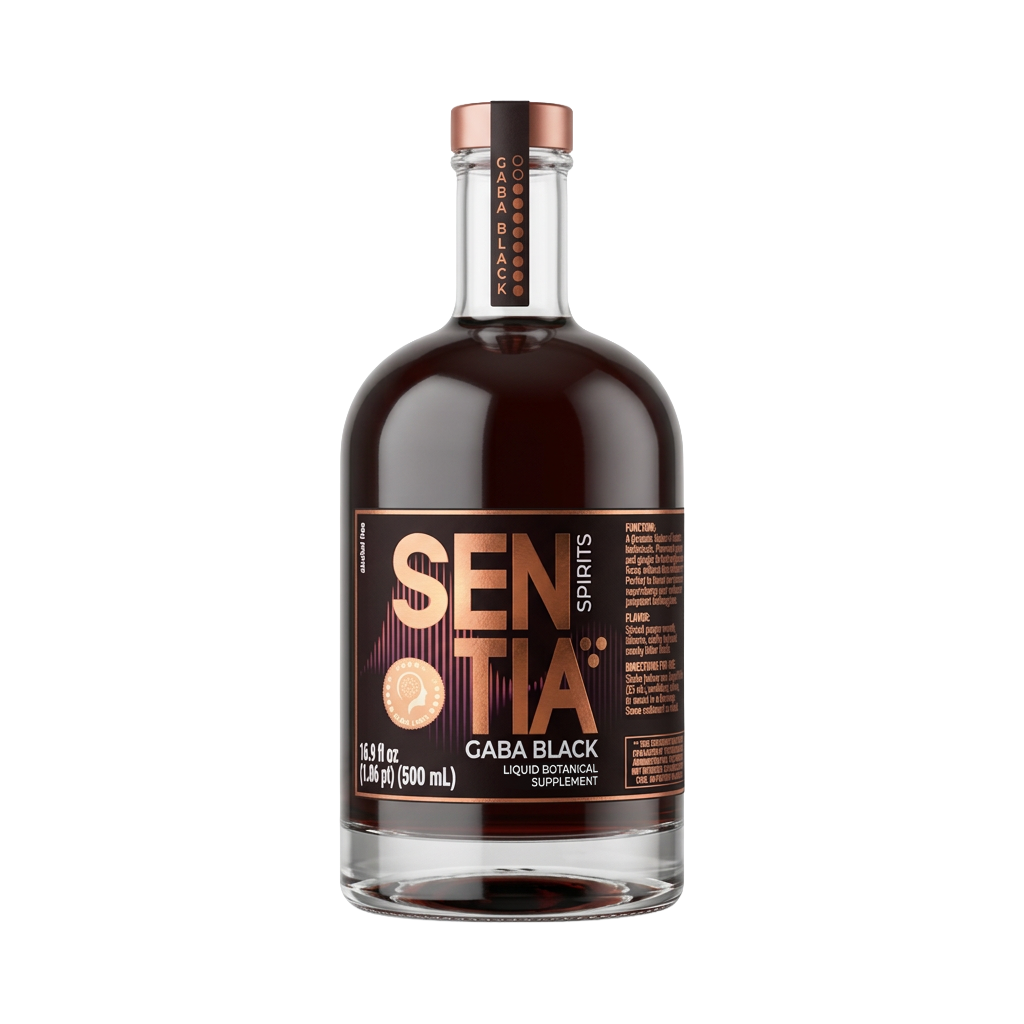
SENTIA is designed around the idea that you can support the brain’s natural GABA system without alcohol.
Rather than flooding the body with GABA as a supplement, SENTIA uses botanicals chosen for compounds that can interact with the brain’s own calming system. Some of these compounds act like positive allosteric modulators — a mouthful, yes, but it simply means they help your own GABA work more effectively.
Think: helping the brake pedal respond more smoothly, not slamming it to the floor.
Why the GABA pathway matters now
Modern life is basically a stress buffet: notifications, deadlines, bad sleep, social pressure, too much screen time, not enough actual switching off.
The GABA pathway is one of the body’s natural tools for finding balance. Understanding it helps explain why alcohol feels good at first, why it can backfire, and why functional alcohol-free drinks like SENTIA are so interesting.
Experience the GABA feeling
Explore the SENTIA collection:
https://us.sentiaspirits.com/pages/shop
Learn more:
References
[1] Nutt, D. The Brain and Mind Made Simple. Waterside Press, 2021.
[2] Lee, S.-E., Lee, Y. & Lee, G.H. “The regulation of glutamic acid decarboxylases in GABA neurotransmission in the brain.” Archives of Pharmacal Research, 42, 1031–1039, 2019.
[3] Rideaux, R. et al. “On the relationship between GABA+ and glutamate across the brain.” NeuroImage, 257, 119273, 2022.
[4] Dharavath, R.N. et al. “GABAergic signaling in alcohol use disorder and withdrawal: pathological involvement and therapeutic potential.” Frontiers in Neural Circuits, 17, 1218737, 2023.